AI in Smart Manufacturing: Emerging Trends Reshaping Industry 4.0 by 2031
The manufacturing landscape is undergoing a paradigm shift as artificial intelligence transforms every layer of production operations. From predictive maintenance algorithms that anticipate equipment failures before they occur to digital twins that simulate entire production lines in real-time, AI-driven technologies are fundamentally redefining how manufacturers approach efficiency, quality, and adaptability. As we look toward the next three to five years, the convergence of machine learning, edge computing, and IoT-enabled devices promises to accelerate this transformation in ways that will separate industry leaders from those struggling to modernize legacy infrastructure.
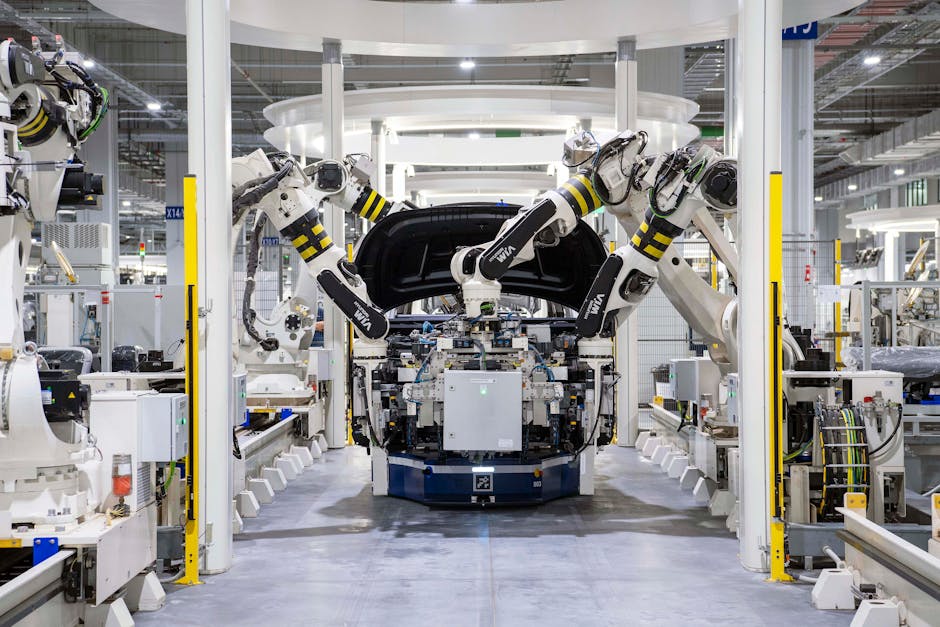
The integration of AI in Smart Manufacturing has already moved beyond pilot programs at organizations like Siemens and General Electric, with production-scale deployments demonstrating measurable improvements in OEE and significant reductions in unplanned downtime. These early adopters are setting benchmarks that will become industry standards by 2030, forcing mid-market manufacturers to accelerate their Industry 4.0 roadmaps or risk competitive displacement. The question is no longer whether to adopt AI-powered manufacturing systems, but rather which technologies to prioritize and how to sequence implementation for maximum ROI while managing change across operational teams.
Autonomous Production Systems and Self-Optimizing Lines
By 2028, we expect to see widespread deployment of fully autonomous production cells that require minimal human intervention for routine operations. These systems will leverage reinforcement learning algorithms to continuously optimize process parameters in response to real-time quality data, material variations, and demand signals from ERP integrations. Unlike traditional automation that follows fixed logic, these AI-driven systems will adapt their behavior based on learned patterns, effectively implementing continuous improvement cycles that previously required Six Sigma black belts and weeks of analysis.
The implications for throughput and quality control automation are substantial. Early implementations at Rockwell Automation facilities have demonstrated 15-23% improvements in cycle times simply by allowing AI systems to fine-tune parameters like temperature, pressure, and timing across injection molding operations. As these algorithms mature and incorporate more sophisticated sensor fusion from IoT-enabled devices, we anticipate even greater gains, particularly in high-mix low-volume production environments where traditional automation struggles with frequent changeovers.
Predictive Maintenance AI Evolution and Prescriptive Analytics
The next evolution in Predictive Maintenance AI will move beyond anomaly detection and failure prediction to prescriptive recommendations that integrate directly with CMMS platforms and maintenance scheduling workflows. Current systems can identify that a bearing will likely fail within 72 hours based on vibration signatures and thermal patterns. By 2029, these systems will automatically generate work orders, verify parts availability through BOM cross-references, schedule technicians with the appropriate skill certifications, and even pre-position replacement components based on optimal maintenance windows that minimize production impact.
Companies exploring custom AI solutions for predictive maintenance are discovering that the real value lies not in prediction accuracy alone but in the integration depth across existing manufacturing execution systems. ABB's recent deployments demonstrate how AI-driven maintenance systems can reduce maintenance costs by 20-30% while simultaneously improving equipment availability, creating a compounding benefit that traditional time-based maintenance approaches cannot match.
The convergence of predictive maintenance with Digital Twin Technology represents another frontier. Instead of analyzing individual equipment in isolation, AI systems will evaluate entire production ecosystems, identifying cascade effects where one component's degradation impacts downstream processes. This holistic approach to asset health management will become standard practice among manufacturers operating complex, interdependent production lines where a single failure can halt multiple processes.
Digital Twin Technology and Real-Time Simulation Capabilities
Digital twin implementations will mature significantly over the next three to five years, evolving from static models used primarily for design validation into dynamic, continuously updated virtual replicas that mirror physical production in real-time. These advanced twins will ingest data from thousands of sensors across SCADA networks, material handling systems, and quality inspection stations to create living models that manufacturers can use for scenario planning, virtual commissioning, and predictive what-if analysis.
Honeywell and Siemens are pioneering applications where digital twins serve as training environments for AI algorithms before deployment to physical equipment. This approach dramatically reduces the risk associated with AI experimentation on production assets, allowing manufacturers to test optimization strategies, failure scenarios, and process modifications in simulation before committing to physical changes. By 2030, we expect this virtual-first approach to become standard methodology for process engineers and production managers evaluating improvement initiatives.
The integration of digital twins with generative design AI will enable manufacturers to conduct virtual product lifecycle management, identifying manufacturability issues and optimization opportunities before tooling investment. This capability will prove particularly valuable in industries with long lead times and high tooling costs, where design iterations in physical space carry substantial time and financial penalties.
Supply Chain Intelligence and Adaptive Manufacturing Networks
AI in Smart Manufacturing will extend well beyond the factory floor to encompass entire supply chain visibility ecosystems. By 2029, leading manufacturers will operate AI-powered control towers that provide real-time visibility into supplier health, logistics constraints, demand volatility, and inventory positions across multi-tier supplier networks. These systems will move beyond descriptive analytics to prescriptive recommendations, suggesting alternative sourcing strategies, inventory repositioning, or production schedule adjustments in response to disruption signals detected through natural language processing of news feeds, weather data, and transportation networks.
The shift toward demand-driven manufacturing will accelerate as AI systems become more sophisticated at interpreting market signals and translating them into production plans. Material requirement planning (MRP) systems will evolve from backward-looking scheduled approaches to forward-looking predictive models that anticipate demand shifts before they appear in order backlogs. This capability will enable just-in-time production strategies that were previously too risky in volatile markets, reducing working capital tied up in finished goods inventory while maintaining service level commitments.
Manufacturers will also deploy AI-driven supplier quality management systems that predict quality issues based on supplier process data, raw material certifications, and historical defect patterns. This predictive approach to incoming quality will reduce inspection costs while catching potential issues before they enter production, a critical capability for industries with stringent regulatory compliance requirements.
Human-AI Collaboration and Augmented Workforce Models
The future of AI in Smart Manufacturing is not about replacing human expertise but augmenting it through intelligent decision support systems. By 2030, production supervisors will routinely interact with AI assistants that provide real-time recommendations on resource allocation, quality investigations, and process adjustments based on analysis of data streams that would overwhelm human cognitive capacity. These systems will effectively democratize expertise, allowing less experienced operators to make decisions informed by decades of institutional knowledge encoded in machine learning models.
Root cause analysis for quality escapes and process deviations will be accelerated through AI systems that can correlate thousands of process variables, maintenance records, material lot codes, and environmental conditions to identify contributing factors that human investigators might miss. Rather than spending days manually reviewing production data and interviewing operators, quality engineers will review AI-generated hypotheses ranked by probability, dramatically reducing the time from problem detection to corrective action implementation.
Change management will become increasingly critical as these technologies deploy. Manufacturers that invest in comprehensive training programs and create clear pathways for workforce upskilling will realize significantly better ROI from AI investments than those that treat technology deployment as purely a systems integration challenge. The organizations that successfully navigate this transformation will foster cultures where operators and engineers view AI as a collaborative partner rather than a replacement threat.
Conclusion
The trajectory of AI in Smart Manufacturing over the next three to five years points toward increasingly autonomous, adaptive, and intelligent production ecosystems that will redefine competitive dynamics across global manufacturing. Organizations that begin building capabilities now in predictive maintenance, digital twin simulation, and AI-driven process optimization will establish advantages that become increasingly difficult for late adopters to overcome. The convergence of these technologies with established practices like Lean manufacturing and Six Sigma will create hybrid methodologies that combine human expertise with machine intelligence in powerful new ways. As manufacturers explore these opportunities, many are discovering parallel innovations in adjacent domains, with Generative AI Financial Solutions offering similar transformative potential for financial planning and analysis functions that support manufacturing operations. The winners in this transformation will be those organizations that approach AI adoption not as a technology initiative but as a fundamental reimagining of how modern manufacturing creates value through the strategic fusion of human insight and machine intelligence.


Comments
Post a Comment